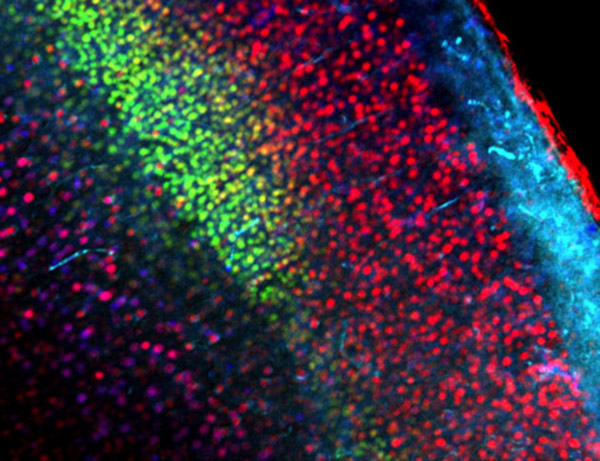
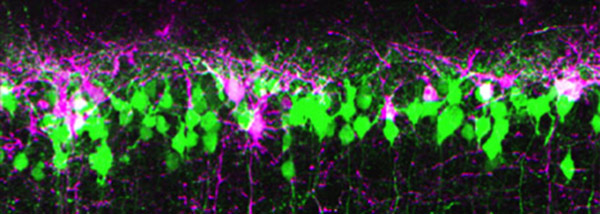
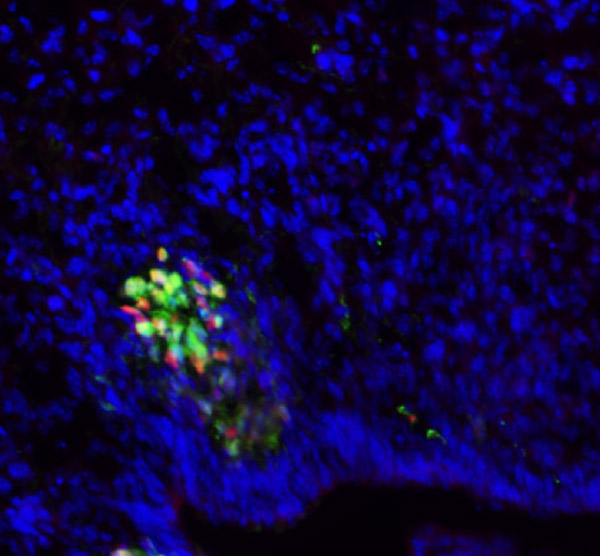
The neocortex, the most complex structure of all vertebrate brain systems, is organized into cytoarchitectonic groups of neurons that process unique sensory inputs, such as pressure, light and sound. This highly ordered structure is nonetheless generated from a relatively simple sheet of neuroepithelium during development. Research in our laboratory aims to understand how these diverse arrays of cortical neurons are specified and coordinated into high-functional territories: 1) What is the mechanism by which diverse cell fates are determined in the neocortex? 2) How are neurons precisely arranged into distinct cortical layers and areas? 3) To what extent does the establishment of functional areas rely on environmental inputs?
Recent work from the laboratory has shown that the fate of neocortical neurons is controlled through cortical intrinsic programs in which neuron fate is established by temporal changes in transcriptional regulatory network. However, in the mature cortex, cortical areas differ in their types and numbers of specific layer neurons along both the anterior-posterior (AP) and medial-lateral (ML) axes. We are exploring the extent to which intrinsic determinants control the specification of neuronal subtypes within discrete regions of the neocortex, as well as the extrinsic influences that refine the boundaries between functional areas of neocortex. To further these studies, we employ genetic manipulations in mice that will enable conditional loss of gene and cellular functions, recombination-mediated cell-lineage tracing, and systematic approaches to identify novel molecules responsible for precise areal specification. Through these studies we wish to understand the mechanistic basis by which unique sensory perceptions and functional circuitries develop in the human neocortex.
A:…
A:…
A:…
A:…
A:…
A:…
A:…
A:…
hanashima[at]cdb.riken.jp

![CDB [RIKEN CENTER FOR DEVELOPMENTAL BIOLOGY]](http://www.cdb.riken.jp/en/wp-content/themes/cdb_en/images/common/fLogo2.png)
2-2-3 Minatojima-minamimachi, Chuou-ku, Kobe 650-0047, Japan
TEL : +81-78-306-0111
FAX : +81-78-306-0101
E-mail : cdb[at]cdb.riken.jp